

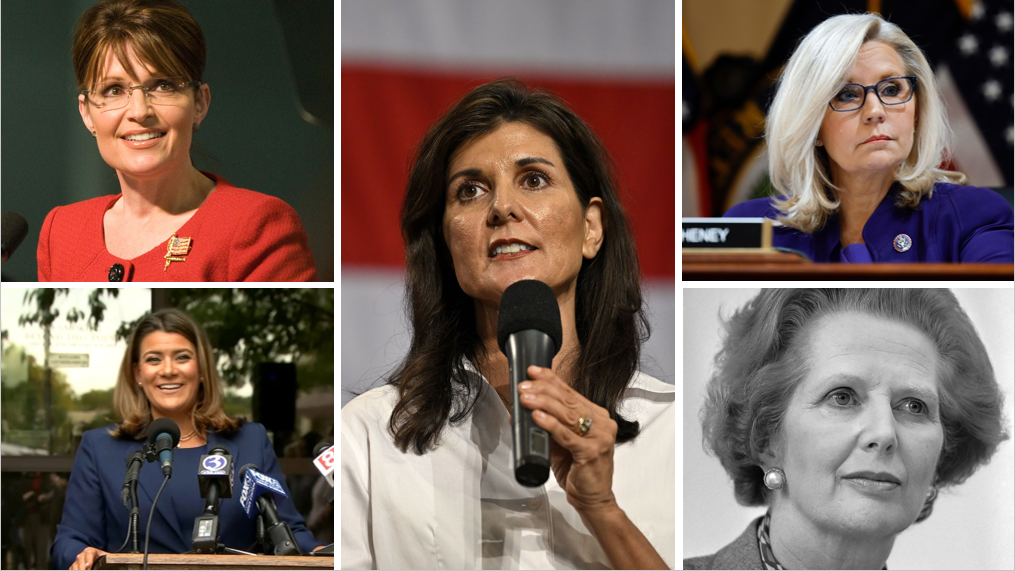
Despite my usual resistance to election speculation too far in advance of polls opening, the conversation about each party’s 2028 nominees is nevertheless underway. Progressive names like New York Rep. Alexandria Ocasio-Cortez or Michigan Gov. Gretchen Whitmer have been floated among Democrats, but some remain concerned about a woman’s chances against the next likely Trump-backed GOP candidate. While either of these names – or others – would make history, the greater question at hand is not who could be a victorious nominee, but whether the first woman president can be a Democrat – or must she be a Republican?
Of course, the Republican Party has never really presented itself as or earned the title of the “party of women.” The GOP has never before nominated a woman for the presidency, coming closest in 2008 when former Alaska Gov. Sarah Palin was nominated for vice president with the late Arizona Sen. John McCain. Since then, Democrats have successfully elected an African American man president, nominated a woman who captured the popular vote, elected a mixed-race woman vice president, and later nominated her to the top of her own ticket. And even still, a woman has yet to sit behind the Resolute Desk – though a 2024 YouGov poll reports 52% of Americans hope to see that in their lifetime. Ironically, however, it may not be the party of the last century’s social progress that elects our nation’s first female Commander-in-Chief. Because many Democratic women, like Rep. Ocasio-Cortez, are viewed through a lens of ideological extremism, it might take a moderate Republican woman to win over the electorate instead.
That liberal perception is not baseless, however. While a US Senator from California, Kamala Harris was ranked as the second most liberal senator, a label which, having followed her during her vice presidency, may have hindered Harris’s national appeal. One Gallup poll shows that the former vice president was seen during the 2024 election as “too liberal,” 51% of participants characterizing her in that way, leaving those participants less likely to vote for her. Such a perception of liberal extremism seems to have been a deterrent for voters in 2024, and could be for women in the future. According to another 2024 Gallup poll, women over the last few decades have become increasingly liberal, much more so men, who have consistently averaged about 20% identifying as “liberal” or “very liberal” across age groups, compared to the growing 30% average across all ages of women. A female Democrat, thus, seems to be perceived as a more extreme liberal by virtue of her gender. Overtly promoting progressive issues and policies adds to that, creating the image of an liberal ideologue that often proves disqualifying for independent voters.
Perhaps the only remedy to that situation of perception might be for a female Democrat to moderate her views, thus appearing less liberal and appealing to the millions of unaffiliated and centrist voters. Harris definitely attempted that during her 2024 campaign, discussing her own gun ownership on multiple occasions seemingly in an attempt to appeal to second amendment advocates on the right. However, winning the presidency may be even easier for a woman who holds authentic conservative values and positions herself as a centrist capable of appealing to voters across the political spectrum. So, it may be easier for a Republican woman to ascend to the presidency than a female Democrat perceived as an extreme liberal.
In recent history, Republican women, especially in Congress, have more often succeeded in appealing to moderates and voters across the aisle. According to The Lugar Center partnered with Georgetown University’s McCourt School of Public Policy, among the top ten bipartisan senators are Republicans Sen. Susan Collins (ME) and Sen. Lisa Murkowski (AK), making up one-fifth of female Republican senators, while only an eighth of female Democratic senators score that high. In comparison, former Vice President Harris scored 93rd in bipartisanship as a senator in 2019, and former Sec. Hillary Clinton scored 76th on the same senate index in 2009. As was mentioned earlier, perhaps nominating Democrats with moderated views could help in this scenario, but still, most Republican women in Congress appear less extreme than their Democratic counterparts, offering them an advantage.
This dynamic does not seem to be unique to the U.S.; we’ve seen it internationally and more locally as well. Take, for example, the United Kingdom, an increasingly socially liberal country that has, since the 1980s, already elected three female Prime Ministers, all from the nation’s Conservative Party. Perhaps, like some women in the U.S., British Labour Party women may be perceived as too liberal to lead the British Parliament. As another example closer to home, Connecticut, a state that has not cast its electoral votes for a Republican since 1988, has elected only two female governors: Ella Grasso, a moderate Democrat (characterized by fiscal conservatism) in the 1970s, and Jodi Rell, a moderate Republican in the late 2000s. Both have shown that extremism – for nearly any candidate, but especially for a woman – is a hard sell. Currently in Connecticut, Mayor Erin Stewart of the City of New Britain has begun her gubernatorial campaign. A Republican, Mayor Stewart has built her brand around clear and responsible government service on the ground, having served as mayor for twelve years and having avoided too much association with Republican extremism on the national level.
There are, of course, several Republican women who are not only qualified but positioned to make serious runs for the presidency. What seems to be the only thing standing in the way, especially in the last three election cycles, is their ability to capture their party’s nomination. However, in 2028, that could be different. Donald Trump, despite what he and some members of his administration have claimed, cannot be elected to another term as President, and much of his party seems to prefer to move on. In doing so, perhaps a more moderate Republican like former Gov. Nikki Haley or former Rep. Liz Cheney could pose tough competition against likely Trump-anointed contenders, Vice President JD Vance or Sec. of State Marco Rubio.
Perhaps the path to the White House for a woman is not through progressivism and strained moderation but with an authentic centrist conservative vision. If Democrats dodge the potential risk of another lost election with a female nominee, and Republicans seize the bold opportunity to support a moderate female candidate, history could finally be made in 2028, just not in the way we have long expected. That long-unbroken glass ceiling might finally shatter – not by the roar of a liberal lioness, but by the steady swing of a conservative stateswoman.